
By Melanie Wilson
When we first started cleaning up trash on Highway 14 in Washougal, the litter was so thick you could fill three or four lawn-size leaf bags by taking just a few steps in any direction. This was at the tail end of the pandemic, and the highway hadn’t been cleaned in at least a couple of years.
We were just forming ECCA at the time, and the trash project was exactly the kind of work we wanted to do: hyper-local and active. It involved making an immediate, visible and important difference in our shared environment, and it took a bunch of people, working together, to do it.
We also liked it because it was a problem we thought we could actually solve. Not just temporarily, by picking up the trash, but permanently, by figuring out how the trash gets there in the first place and then attacking the root causes.
We liked it because it was a problem we thought we could actually solve. Not just temporarily, by picking up the trash, but permanently, by figuring out how the trash gets there in the first place and then attacking the root causes.
Could we really do that, though? Some of our volunteers were skeptical. But despite their doubts, we decided to push ahead. We wanted to believe we could make a lasting improvement if we just kept at it and pursued every angle.
Fast forward four years. We’ve attracted upwards of 50 volunteers from all over East County who have picked up tens of thousands of pounds of trash between Washougal and E. Vancouver. We’ve learned what the trash looks like and where a lot of it comes from. We’ve learned why the state hasn’t been able to keep our highways clean on its own. And we’ve learned that there is lots of blame to go around: individuals, businesses, whole industries. We’re all part of it, whether we think we are or not.
Now we finally know enough to put a real dent in this problem. ECCA and some other dedicated advocates have joined to create Clean Highways Clark County, a group solely dedicated to beautifying our trash-strewn highways. While still in its formative phase, the group is already at work, setting up business sponsorships that will fund contractors to clean segments of the highways around Vancouver. We’re supporting new volunteer Adopt-a-Highway teams as they get up and running. We’re arming ourselves with more information about what ends up on the highway, because each type of litter has its own solution. The answer to our problem ultimately runs through state, county and city policymakers and legislators.
ECCA and some other dedicated advocates have joined to create Clean Highways Clark County, a group solely dedicated to beautifying our trash-strewn highways.
If you can help with any of this, we need you. On the business sponsorship front, do you own, work for or know a business that, alone or in combination with other businesses, would pay about $9,000 per year to have a specialist contractor clean a two-mile stretch of any state highway in Clark County six times a year? The payoff is a highway sign with the business’ logo, a visibly more welcoming environment for visitors and customers, and the gratitude of the public.
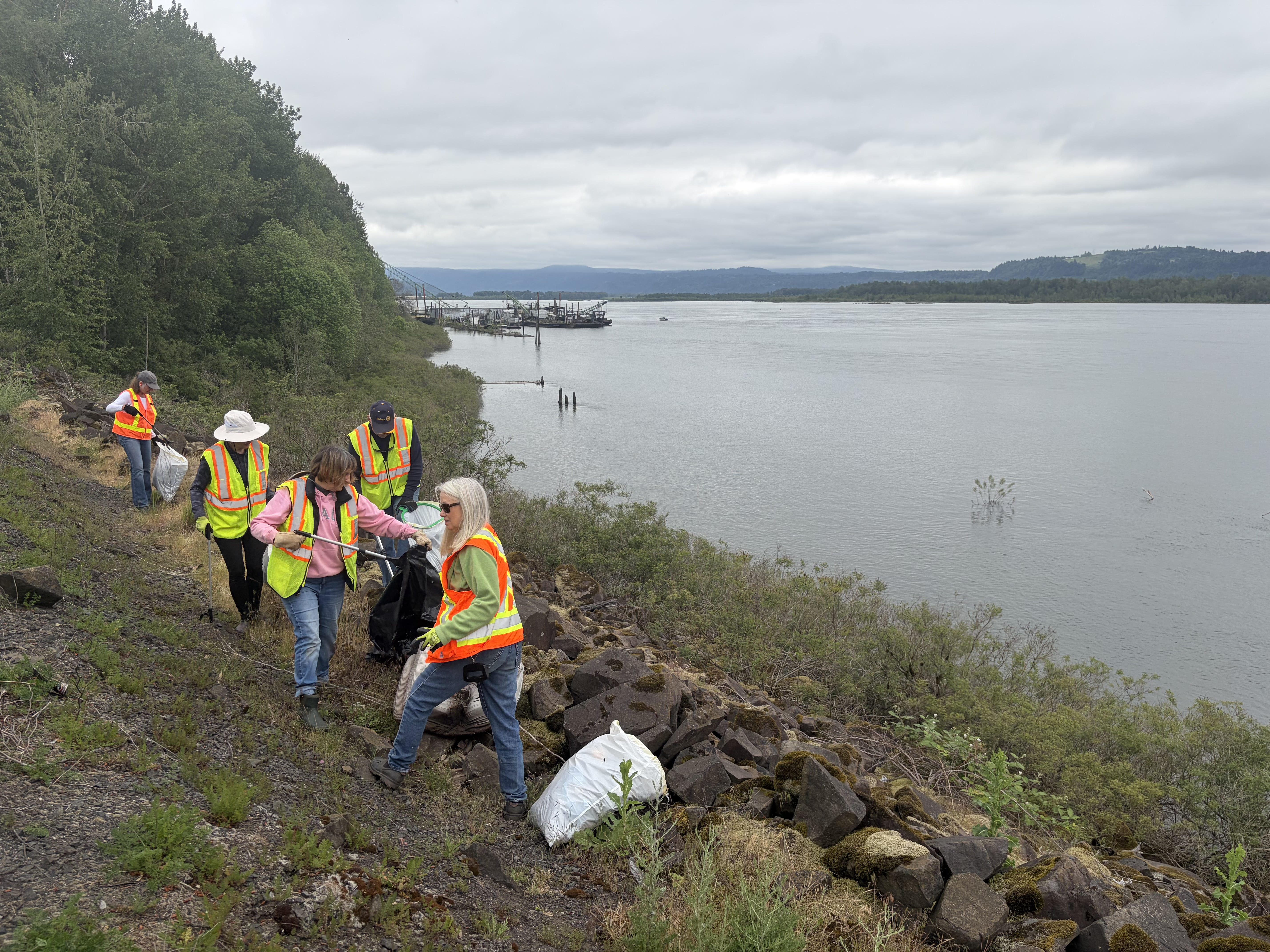
Sound a little lofty? Consider this: Last month, we were on the south side of Highway 14 in the Slough area, where boulders tumble down steeply into the Columbia. As we collected McDonald’s and Starbucks cups, sofa cushions, muddy jackets, beer cans, a five-gallon canister of helium, a volleyball, and innumerable other discarded human objects, one of us suddenly cried out and pointed skyward. Two juvenile eagles spun over our heads. We watched them for a while, transfixed, our trash bags and grabbers in our hands. “We’re doing this for you,” one of us eventually yelled. “We love you,” another hollered. Yes, I thought. On some really elemental level, this is exactly why we do it. Please join us in whatever way you can.
Learn more about our highway cleanup project here. See (and pass along to businesses!) the AAH business sponsorship flier. Want to start your own AAH volunteer team? Let us know, and we’ll help.
Top photo: Our May 20 volunteer team in the Slough area of Camas. Eagles circled overhead while we picked up trash.
Deja un comentario