
There’s been a lot of debate in our society lately about what schools teach students, and how. But as a paraeducator at Washougal High School for almost 10 years, I know that learning goes both ways — our students teach us, too, and when they do, we become better at our jobs.

Our goal is to help every one of our students graduate and begin a successful adulthood. This is complicated because every student is different; each has their own unique set of circumstances, abilities and interests. Some students are self-motivated or have conventional learning styles suited to the school environment, so it’s easy. With others, the journey is harder, and it takes time.
Students who have disabilities or learning impairments can get extra help and individualized support so they can be as successful as possible. (In fact, public schools are required by law to provide this support.) A paraeducator’s job is a mash-up of everything that could possibly be needed to assist these students with their schoolwork: It might involve keeping them on task during a science class, reminding them to pay attention to the teacher, or taking notes for them. We often have to provide tech support, showing them how to log on and use the various Google features on their Chromebooks. We need to hold them accountable while modeling communication skills, good behavior and positive learning habits.
Some students are self-motivated or have conventional learning styles suited to the school environment. With others, the journey is harder, and it takes time.
None of this can happen until we’ve built a good, trusting relationship with the student. Paraeducators — paras, for short — can feel like they’re in a tricky spot sometimes. They have to really get to know each student and be available when they are ready to work. This doesn’t always happen on schedule, which means that we sometimes need to act as the protective coating between the teacher and the student who’s not in the right headspace to learn and study.
There can be many reasons why some students struggle to buckle down and get to work. For those who are not neurotypical, like kids on the autism spectrum, school can be a challenging environment that overloads their senses and throws them off task for hours at a time. Information processing speed varies from person to person, and some students take in information at a slower pace. I have seen many students whose basic needs just haven’t been met — sometimes it’s clear they haven’t had a healthy meal or a good night’s sleep for a couple of days. And if there’s depression, anxiety, or trauma at home, it’s hard for them to concentrate on homework and class lessons.
There can be many reasons why some students struggle to buckle down and get to work.
We often say, “Meet the students where they are.” If they’re not willing to accept our help, or are not capable of doing something the typical way, we figure out how to make as much progress as we can, while constantly working to improve our relationship with them. This can take days, or it can take months. But with a solid, positive relationship, when the conditions are right for the student, we can get down to work and be productive. It took me a while to figure all of this out, and I’m grateful to a student I’ll call Molly for teaching me.
We first met shortly after I began working at the high school. Molly was a freshman who seemed unusually lethargic and apathetic. Although I didn’t work directly with her that first year, I noticed that she had no desire to be in school, no interest in learning anything. The next year, when I began working in the Integrated Academic Classroom (IAC), our schedules coincided and I was assigned to support her regularly. The IAC is set up so there’s maximum opportunity for staff to help students. It is taught by a special education case manager who oversees the individual goals and accommodations established with the student. Students in IAC typically take math and English classes with this case manager, along with a class devoted solely to doing school work and learning study skills.
In the year since I’d first met her, Molly’s behavior had darkened to uncooperative and defiant. She frequently made up excuses to leave class, usually under the pretext of needing a bathroom break, and I’d find her roaming the halls. In class, Molly wouldn’t engage with the lessons, and would reply snarkily when I’d ask her to work with me. There was lots of eye rolling and attitude. I hadn’t experienced such unpleasant behavior with my own kids, fortunately, and I had to constantly remind myself to reserve judgment. All I could do was continue to be available and consistent in offering help, and keep trying to establish a productive and trusting relationship.
In the year since I’d first met her, Molly’s behavior had darkened to uncooperative and defiant. She frequently made up excuses to leave class, usually under the pretext of needing a bathroom break, and I’d find her roaming the halls.
Eventually, Molly turned around. Why? I never knew for sure, but there could be many reasons. The IAC teacher had been working with her closely, teaching her about accountability and how to cultivate healthy relationships with her teachers and peers. She also guided Molly through the process of breaking the cycle of abuse with her mother and boyfriend. All of that helped her gain confidence in her own abilities. I suspect that Molly had also matured enough to realize that in order to complete high school, she’d have to face reality and actually do some work, pass her classes and learn a few things. To do that, she needed my help.
In any case, Molly came to me one day and asked if she could talk to me in the hall. Out there, out of earshot of the other students, she poured out a heartfelt apology for the way she’d treated me. She acknowledged that I was one of the few people in her world who was here to help, and she was sorry to have been so disrespectful.
Out there, out of earshot of the other students, she poured out a heartfelt apology for the way she’d treated me.
This moment was a revelation, a lesson that continues every day to inform my work as a paraprofessional. Students aren’t all on the same schedule. Many have challenges, emotional trauma or learning disabilities that can profoundly affect their ability to function in a typical school environment. And they are just kids. Someone may be unresponsive, unproductive and disrespectful today, but that doesn’t mean they will be tomorrow, or every day for the next four years. And when the time comes — when they decide to get down to work — paras and teachers need to be ready to work along with them. Thanks to Molly, I’ve learned to respond to difficult behaviors by finding some way of saying, “I am not going to give up on you.” That’s exactly the message that some students need to hear.
Students aren’t all on the same schedule. Many have challenges, emotional trauma or learning disabilities that can profoundly affect their ability to function in a typical school environment. And they are just kids.
I think that’s what Molly heard. She began earnestly trying, engaging, and asking for help from me and the other staff. Small successes — an assignment completed on time or a good grade on a paper — inspired her to work even harder, and eventually she began earning passing grades. She even enrolled in an Advanced Placement psychology class during her senior year. It took an extra semester or two for her to complete enough credits to graduate, since she had lost time to the struggles of her first year. But graduate she did, taking technical business management classes along the way. Now, in her mid-20s, she has a full-time job and is doing well.
This experience made me realize that the bolt of inspiration doesn’t strike us all at the same time. It’s a hard lesson to learn: Even though we might be ready to get to work or make important changes, we can’t force our students, coworkers or loved ones to move at the same speed. We need to have patience. We need to be present, available, and not give up on one another so easily.
Barb Seaman worked as a paraeducator at Washougal High School for eight years. Now she is a library assistant at the school. She lives in Washougal with her husband.
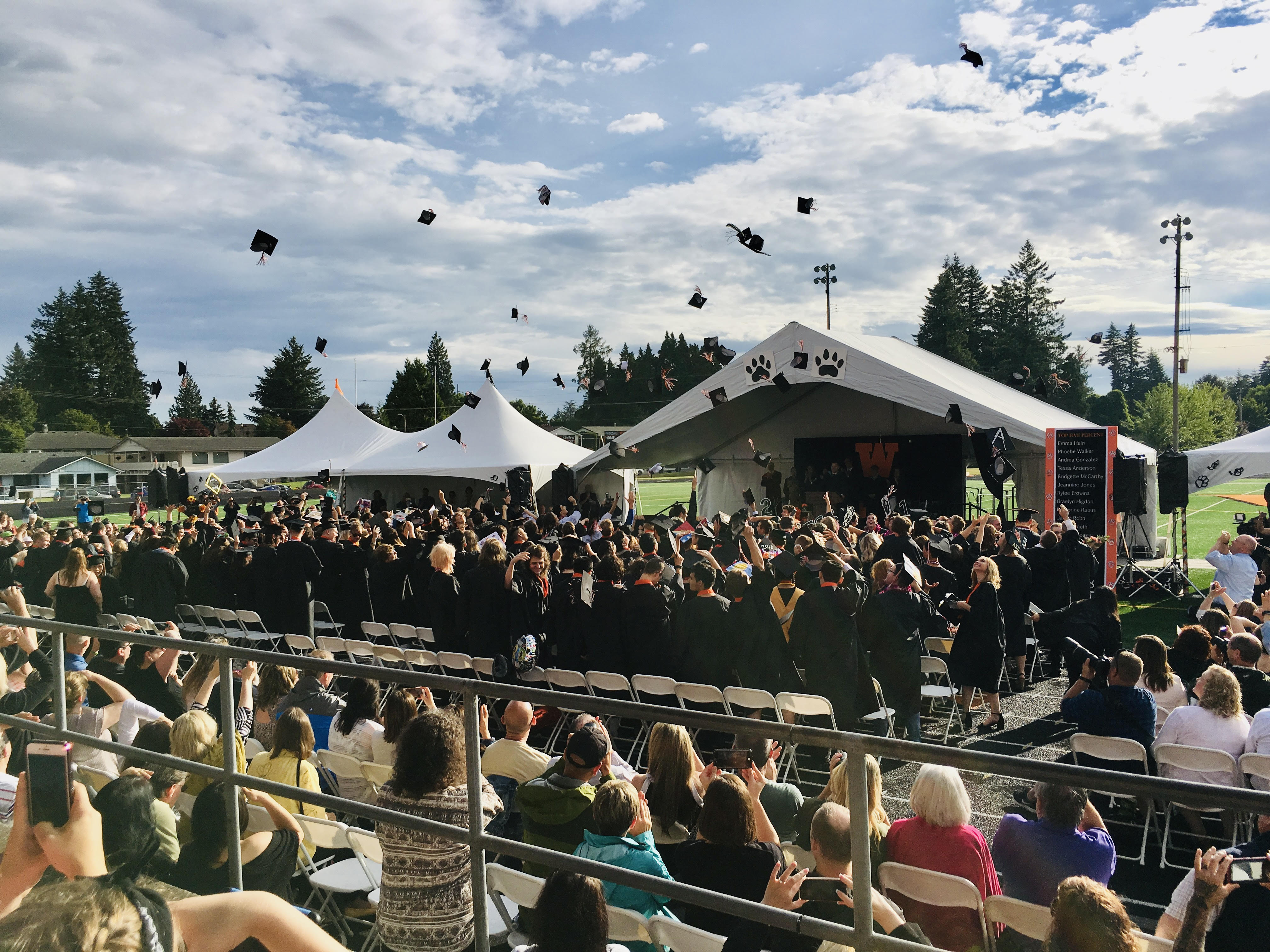
In the top photo, Washougal High School graduates toss their caps into the air at their graduation ceremony in 2018. Courtesy Barb Seaman.


Deja un comentario