

Last weekend, on a rare day without rain, I planted an arborvitae to hide the view of the house next door. (There’s nothing objectionable about the house next door; I just like a sense of privacy.) Ever since, though, I have wrestled with my conscience. I know how stupid that sounds, but sometimes I cannot escape my horticultural partisanship. I guess you could say I have an obsession with being environmentally correct.
You see, I am a native gardener, or at least that’s what I want to be. I know and swear by the teachings of Doug Tallamy, who calls my yard (all yards, actually) “nature’s best hope.” Tallamy, an entomologist from the University of Delaware, has researched the impact of different plants on insects and has proven how vital native plants are to native insects, and how in turn, those insects are the source of sustenance for nearly all the rest of the native wildlife in that habitat, especially birds.
Tallamy considers caterpillars the environmental canary in the coal mine. To drive his point home, he literally counts them. He reports that one pair of chickadees need over 4,600 caterpillars to raise one clutch of chicks; a native oak tree is host to over 500 species of caterpillars while the non-native Gingko hosts just one species. “No insects, no baby birds,” he writes, and adds that planting a Gingko or small ornamental tree is like planting a lifeless statue.
Tallamy says that planting a Gingko or small ornamental tree is like planting a lifeless statue.
The impact on birds almost beggars belief. In 2019, the Cornell Lab of Ornithology reported that in the last 50 years across North America, there has been a decline of nearly 3 billion birds — “a staggering loss that suggests the very fabric of North America’s ecosystem is unraveling.” A primary cause of the decline? The use of pesticides and, yes, the decline of habitat. When I first read this, I had to wonder whether anything I could do on my own little plot of land really matters.
The answer seems to be yes, maybe there is. As one solution, Tallamy has proposed a novel approach to increase habitat and provide protections: more national parks. But not the typical federally owned kind, but “homegrown” ones. He points out national parks in the continental U.S. have about 48 million acres of protected habitat. At the same time, there are 40 million acres of lawn, almost as many acres in our yards as in all the national parks put together. If we could just turn half of our lawns into native habitats, we could have a huge impact on our environment and the health of our insect and bird populations. His plan is called, naturally enough, Homegrown National Parks.
If we could just turn half of our lawns into native habitats, we could have a huge impact on our environment and the health of our insect and bird populations.
Locally, the Watershed Alliance of SW Washington, Portland Audubon and Columbia Land Trust endorses the idea of adding native plants to yards. They have partnered to create the Backyard Habitat Certification Program, which supports the efforts of urban and suburban landowners in creating natural backyard habitats. The program asks participants to adopt sustainable gardening practices and set a goal of turning a portion of their yard into native habitat: just 5% of native habitat in a yard is certified at the silver level; 15% at the gold level; and 50% at the platinum level. And they don’t just send you a sign that declares your participation in the program; they actually visit your yard twice. On their first visit they help you identify the weeds and invasive plants as well as the natives you already have. They suggest how you should add layers (trees, large shrubs, small shrubs, perennials, and ground cover) to your habitat. They tell you how to use native plants to support local species, propose ways to deal with storm water runoff, and tell you which plants don’t require the use of pesticides. In short, they explain how each homeowner, in their very own yard, can embrace the principles of environmental stewardship. On top of that, they provide a detailed written assessment with the goals outlined to earn certification. On the second visit they check out your work and offer any last bit of advice that may help you maintain your habitat.

To me, their help was invaluable. An area of my yard I thought was overtaken by weeds in fact hid a number of native plants that I could build the rest of garden around, saving me time and money. And all of this in-depth support cost me $35 (there is also a sliding scale to help increase accessibility and encourage participation). Even better, the program was actually a net cost savings, since committing to the program entitled me to discounts on native plants in several local nurseries. I have already saved far more than that initial payment.
An area of my yard I thought was overtaken by weeds in fact hid a number of native plants that I could build the rest of the garden around.
So I am convinced. As Portland author and blogger Eileen Stark writes: “Real gardens grow natives.” So I will and I am. But the truth is, dare I say it — I still love the beautiful, very non-native hellebores and hydrangeas!

Three years ago, when I went to my first garden club meeting in Washougal, my neighbor enthused that “You can grow anything here!” That wasn’t true in Texas, my previous home, so I couldn’t wait to learn more and get started. My first visit to the Camas nursery One Earth Botanical convinced me she was right — possibilities abound in the Pacific Northwest. The nursery’s owner Stephanie Beach promotes sustainable gardening, and in her own garden seeks to create “an oasis for wildlife.”
Her garden is ravishing. From spring through fall it is almost outlandishly decked out in blooms. She has mastered the art of layering a plethora of plants so as to guarantee sequential bloom: a must-have for the pollinating insects. But, while the plants are adapted to our climate and soil — what locals call “hardy” plants — most of them are not native to our ecoregion. Yet how I dream of creating a part of her garden in my own yard.
But I am really in luck. What I love about both Tallamy’s ideas and the Backyard Habitat program is that they don’t ask for anyone to give up the non-native plants completely. My plan is to plant all of my backyard hillside in native plants, while putting most mostly ornamentals in front. In fact, I’ve already started.
Working on the tall shrub layer I was missing, I have just planted an osoberry (Indian Plum), a twinberry, a serviceberry, an oceanspray, and two native dogwoods.

To my great fortune, I discovered a new native plant nursery in Washougal. Hannah Schrager, a forest ecologist turned nursery owner, started Good Year Farms in 2020, during the pandemic, no less. Not only was she able to get plants for my first stage of planting, but she helped me plan on their placement and spacing. Working on the tall shrub layer I was missing, I have just planted an osoberry (Indian Plum), a twinberry, a serviceberry, an oceanspray, and two native dogwoods. All have buds right now and I am so excited to see them in bloom. It’s a work in progress, with lots more to do, but my hope is to well exceed the 50% native level — I’m going platinum!
Somehow, though, I still feel guilty. It’s a little ridiculous, I know. I find myself wondering about how I’ve become such a purist in my gardening, with no room for compromise. I get caught up in a moral imperative to be a native gardener, and bending is hard. But I’m slowly learning the art of compromise; I’m learning to see the natural world and my own garden from another perspective. I’m finding common ground between the old type of gardening and the new.
I think I need to plant more hellebores.
Ginny Frederick is a dog-loving former teacher turned gardener who forfeited the sun she loved in Texas for the grandchildren she loves in the PNW. Living and learning, she is always looking for ways to find beauty and purpose in her garden, her community and her life.
Join or learn more about the Community Garden Club of Camas-Washougal, which also has period plant sales.
Do you have a native plants or a native garden you’d like to show off? Send your photos to ecca@eastcountyvoices.org.
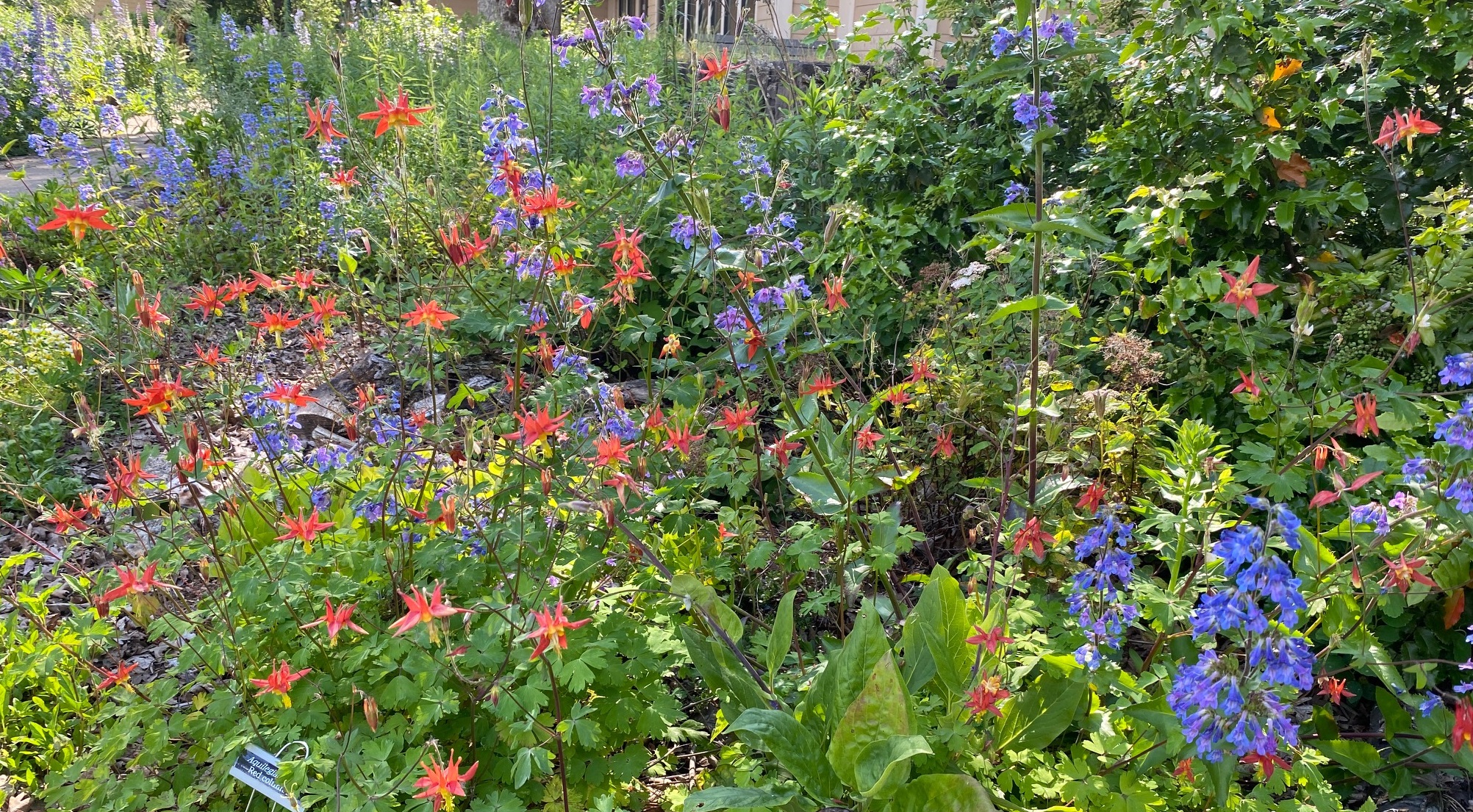
Top photo: The Hegewald Center Demonstration Garden in Stevenson.

Deja un comentario