
By Barb Seaman
About a hundred years ago, an orca whale ventured up the Columbia River and swam around in the waters near Camas. A man from Gresham caught it, killed it, and preserved it in a glass tank full of formaldehyde. He made a kind of traveling whale exhibit, hauling his preserved oddity to various fairs and carnivals around the PNW. Eventually, the exhibit lost popularity, or maybe the smell of rotting whale became unbearable, and the giant sea animal was buried on some rural Hamilton Mountain property, just north of Camas. That’s the way I remember the story, told to me by an acquaintance I’d met on a walk in the park.
Shortly afterwards, in a chat at our mailbox, a neighbor reminisced about growing up on a cattle ranch in what is now East Vancouver. Each spring, her dad floated a barge full of cows over to Government Island to let them roam and graze until fall. She spoke of summer days exploring the beaches and woods of the island – which was a huge surprise to me, since in my mind, the island had never been anything but some useless land we pass above on the 205 bridge to Portland.
Each spring, my neighbor’s dad floated a barge full of cows over to Government Island to let them roam and graze until fall. She spoke of summer days exploring the beaches and woods of the island.
I’m grateful that I had the chance to hear these two tales. They spark my imagination and deepen my appreciation for the place where I live. They help foster a richer understanding of the world and people around me. Sometimes, the stories I hear even help shift my perspective so I can be more empathetic.
For example, I’d never understood what it meant to be dyslexic until my boss told me her story. In elementary school she hadn’t learned to read as quickly as her classmates. Her parents and teachers didn’t realize until the end of third grade that she’d just been very good at mimicking her peers and pretending to be able to read. Later, after intensive instruction and a lot of hard work, as a student in a private high school the disability presented itself again. As her class began a new assignment, the teacher asked her to read the very first page of the book out loud.
Her parents and teachers didn’t realize until the end of third grade that she’d just been very good at mimicking her peers and pretending to be able to read.
The first word was “Preface,” which in her mind was pronounced “Pre Face.” A small argument ensued after the teacher tried to correct her, but her dyslexic brain had her convinced that the word was absolutely, without a doubt, “Pre Face.” The frustrated teacher sent my boss to the office, and her parents were called. I was so amused to hear this story, but after some time and consideration, I realized how it changed my understanding. I could see more clearly how people could be profoundly affected by disabilities that go unnoticed by others.
Stories are important to us humans – our hunger for them is one of the things that makes us human. We seek them out as a way of understanding one another and feeling more connected. People who tell their stories form stronger communities. That’s why we at ECCA want to capture the stories of people from East County and present them in a format that everyone can access.
We want to give voice to anyone with a story to tell — an experience that family and friends should know about, or a story that sheds light on some part of our rich collective history. It’s healthy to tell our own stories, and there’s value in listening to other people’s.
We’re calling our project “East County Voices,” and modelling it after StoryCorps. If you don’t know StoryCorps, take a listen here. These audio stories – which are edited segments of recorded conversations between pairs of family members, friends or coworkers – have a special power to help us understand and appreciate one another.

The great thing about these audio stories is that they’re a low-cost, relatively simple way to gather intimate local voices – perfect for organizations like ours that are dedicated to growing community through mutual appreciation and respect. We want to have 20 local interviews on our website, listener-ready, by the end of this year. We’re recording our fifth and sixth conversations next week.
So what is a story in your family or community feels important to preserve right now? What relationship or event has had a big impact on your life? What relationship do you want to honor? We invite you to record an uninterrupted, intentional conversation with a family member, friend, neighbor or co-worker. Once you find a conversation partner, we’ll schedule a time to record (audio only, no video). We’ll also provide some guidance and help you prepare. Your conversation can last up to 40 minutes, but could be shorter. Describe your upbringing or ask your partner to describe theirs, describe meaningful events and people in your lives and ask each other things you’ve always wanted to know. There’s no right or wrong way to have these audio conversation as long as you’re talking about things that matter deeply to you.

We’ll share a short segment of your conversation on ECCA’s website, for others in the East County area to experience. But your story will also become part of the StoryCorps archive preserved as part of our national history at the American Folklife Center at the US Library of Congress in Washington DC. Your loved ones – or even researchers or historians interested in the topics of your discussion more generally — will be able to revisit your conversation in the future.
As a nod to the importance of stories to our own cultural understanding, I want to tell one more story that’s been important in my life. Many years ago, an old family friend told a story that I didn’t pay much attention to at the time. Peggy spoke about teaching middle school during the 1960s. The civil rights struggle was intense, riots broke out regularly in the small city where she taught, and her administration had forbidden in-class discussion of any topics related to the conflict.
The student danced for the class, graceful and emotional, as Odetta sang about coming home to her Lord to be free. The moment had been so meaningful that tears formed as Peggy told me about it decades later.
A black student, who was a dancer, had begged to do an interpretive performance to the music of Odetta’s Freedom Trilogy, a popular African American spiritual. Peggy closed the door, blocked the window, cleared the desks from the middle of the room and played the music. The student danced for the class, graceful and emotional, as Odetta sang about coming home to her Lord to be free.
The moment had been so meaningful to my friend that tears formed as she told me about it decades later. I wish she was still her so I could ask her more about it. Why was the girl so insistent about performing the dance? What did Odetta’s song mean to her? How did the other students respond? But Peggy died many years ago, and all these details are lost to me now.
What are you curious about? What historic moments or significant personal experiences would you like others to learn about? Who in your life would you like to tell a story to? Grab a partner and record a conversation for posterity. Click here to learn more and sign up for an audio session.
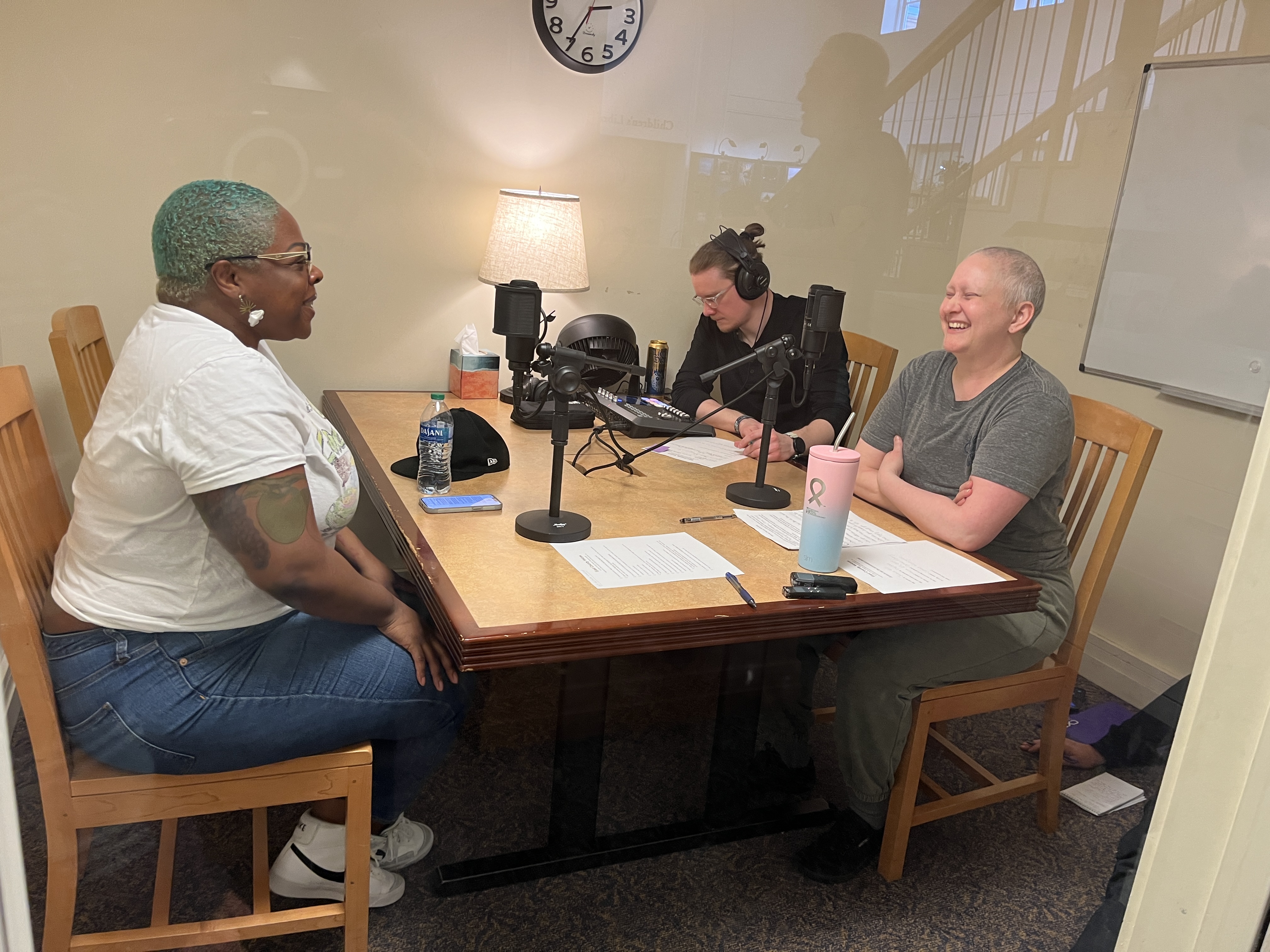
Top photo: Jacquie Hill and Day Bibb talking in the Camas Public Library in March. Audio technician Ransom Reed is recording them. Excerpts of their conversation — and all Voices conversations — will appear on this website soon.
Barb Seaman is associate executive director of East County Citizens’ Alliance. She is heading the Voices project.
Leave a Reply