
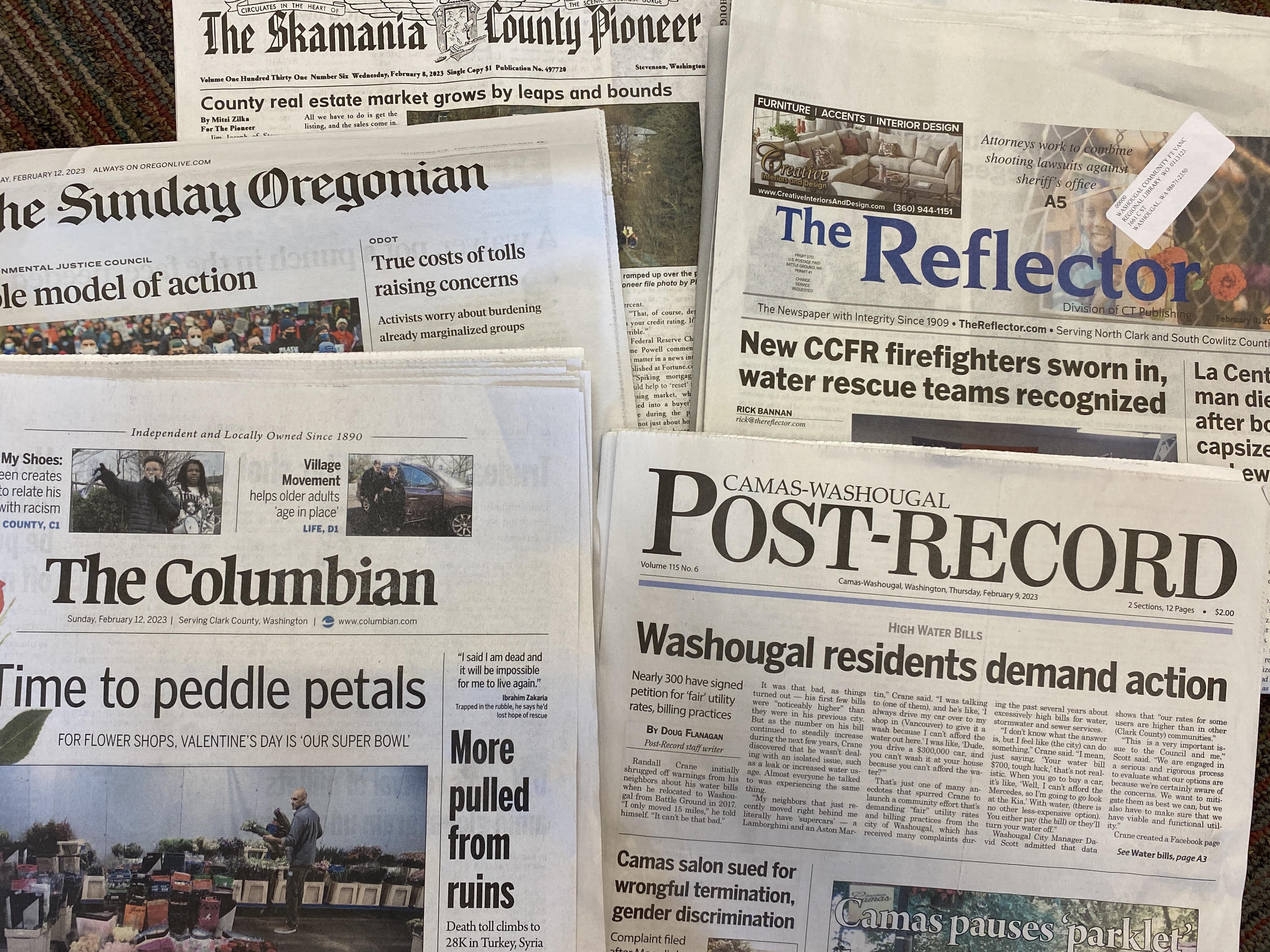
By Dee Ann Finken
The “About” page of the East County Citizens’ Alliance notes the group was formed because of concerns about political polarization in the community. This post is about a development believed to be contributing to this problem in cities and towns across the country.
It’s the decline of local newspapers.
I am co-chair of a League of Women Voters of Washington committee that recently completed an extensive study, “The Decline of Local News and Its Impact on Democracy.” We began our work more than two years ago to look at what has happened as a result of severe staffing reductions at more than 100 newspapers and the closure of more than two dozen others in the Evergreen state.
More than two-thirds of newsroom jobs in Washington have been eliminated, compared with a loss of one half nationally.
The topic captured our attention after national studies tied the decline to a series of negative developments in communities across the country. We were motivated because the mission of the League is to empower voters and defend democracy, efforts made more difficult when communities are breaking apart.
Before League members in Washington could address the issue, however, we needed to learn if our state was experiencing similar negative outcomes.

Sadly, our study concludes it is.
We are defining as newspapers those that publish in print, online or both. As Rob Curley, executive editor of the Spokane Spokesman-Review, puts it, “As long as we understand that the most important part of the word ‘newspaper’ is ‘news’ and not ‘paper,’ we are going to be fine.”
We interviewed more than 50 people and reviewed more than 500 documents. We talked with public health experts, current and former journalists, political scientists, researchers and scholars, and elected officials, from local officeholders to state Treasurer Mike Pellicciotti, Attorney General Bob Ferguson, U.S. Rep. Derek Kilmer and representatives of Sen. Maria Cantwell.
Our research turned up results similar to those reported in the national studies. The negative outcomes include higher costs for running local government, greater public health challenges, a reduction in the number of candidates seeking local office, lower voter turnout, less community engagement and growing political polarization.
When people read news about their neighborhoods, schools and municipal services, they think like locals. When they read about national political conflict, they think like partisans.
Washington State University professor Benjamin Shors described the crisis in disturbing terms. “It’s not a journalism problem,” he told us. “It’s a democracy problem.”
News consumers have been left with few sources of reliable information as local papers have closed or severely cut back coverage of basic news. Particularly troublesome is a lack of consistent and credible information about what’s happening in our communities, such as actions by city and county councils, health department officials, and commissioners and directors of school and special districts. As a recourse, too many readers have turned to social media, where they are frequently bombarded by mis- and disinformation.
“False news … is on average about 70% more likely to be retweeted than information that faithfully reports actual events,” researchers at the Massachusetts Institute of Technology reported.
Louisiana State University’s Joshua Darr and his colleagues found political partisanship increases when readers have less local news coverage and they turn to national news. “In the absence of local news, people are more likely to vote for one party up and down the ballot,” Darr explained.
“When people read news about their neighborhoods, schools and municipal services, they think like locals. When they read about national political conflict, they think like partisans.”
Too many readers have turned to social media, where they are frequently bombarded by mis- and disinformation.
Rowland Thompson, executive director of the Allied Daily Newspapers of Washington, said he, too, has witnessed a growth of political polarization in the state. “People are becoming more and more siloed,” he told our study committee.
Between 2005 and 2020, one in four local newspapers across the country closed, leaving 70 million residents in counties without a newspaper. The most recent data indicate we’re losing about two local newspapers a week nationwide, a trajectory that would result in the loss of one in three newspapers across the country in two years.
In that category, Washington’s losses aren’t as severe. One in five newspapers in the state has closed since the crisis began, and only one county – Asotin in the southeast – doesn’t have a newspaper it can call its own, although residents are served by the Lewiston Morning Tribune in Idaho. Meanwhile, 13 of the state’s 39 counties publish only a single newspaper.
However, newsroom job losses in Washington are greater than those nationally. More than two-thirds of newsroom jobs in Washington have been eliminated, compared with a loss of one half nationally.
The decline in local newspapers means higher costs for running local government, lower voter turnout and less community engagement.
And those cutbacks have been particularly dramatic in some Washington cities, such as in Tacoma, where The News Tribune once was considered among the most robust papers on the West Coast. Staff there is down from more than 120 employees to two dozen who are only able to provide such limited coverage that The News Tribune is considered a “ghost newspaper.”
In Olympia, newspapers from throughout the state used to report on the capitol, but now only a handful of full-time journalists cover the governor, 49 senators, 98 representatives, scores of state agencies and tens of thousands of state employees. The result, said former Associated Press journalist David Ammons, is an enormous imbalance where elected officials and their staffs have more power than ever.
A number of bright people are working to remedy this dilemma. Among the proposals are philanthropic efforts, like The Columbian’s Community Funded Journalism project that has raised $1.4 million to hire additional staff; the creation of nonprofit news operations; and several legislative measures, among them tax credits for newspapers, advertisers and subscribers. Other legislative efforts would level the playing field where Big Tech has reaped billions of dollars.
It’s not clear how fruitful these efforts might prove. And some prompt debate, such as whether government has a role to help ensure a better future for newspapers. Those who believe the government does note that our founders provided protection for a free press in the First Amendment to the Constitution, and reduced postal rates for newspapers.
The 2,700 members of the League of Women Voters of Washington are considering whether to adopt a policy that would allow us to advocate for support of local newspapers in some fashion. If we decide to do so, what that support might look like has not been determined.
What is clear, however, is that our communities are challenged by this news crisis. We are suffering from growing political polarization that doesn’t serve our communities or our democracy.
Dee Anne Finken, who co-chaired the LWV of Washington’s “The Decline of Local News and Its Impact on Democracy,” also serves as the chair of the Communications Team for the League of Women Voters of Clark County. A former journalist, she directed the journalism program at Clark College where she was tenured faculty until her retirement in 2018.

Leave a Reply