
Eric and Fiona Engebretson, long-time educators in the Washougal and Battle Ground public school systems, decided in 2018 to hop off the work treadmill and live their dreams — in France. Below is a Q & A with Eric about how and why they made the move, and the country farmhouse they are lovingly renovating.

Tell me about yourself and your local connections.
I spent all of my teaching career in Washougal, including my student teaching. I spent 17 years in the classroom at Gause Elementary, and one semester at Hathaway. I was also president of the Washougal Association of Educators from 2018-2021. My wife, Fiona, spent 20 years in the Battle Ground School District. She was also president of her local teachers’ union from 2019-2021. She’s a British citizen — half Scottish, half English — with a degree in ancient history from University of Swansea and a masters’ in teaching from Washington State University-Vancouver. She spent 26 years in the U.S.
And at a certain point, still pre-retirement age, you decide to leave it all behind and move to France. Why?
After we married in 2002, we tried to go to the UK every other year to see Fiona’s family and then take a side trip to other parts of the UK or other countries in Europe. Fiona traveled as a child with her family on holiday to France, Germany, etc. I had never been out of North America, so she wanted to take me to the different places she’d been. We both love history, so moving to France was a logical place to plant ourselves.
Another big part was health and age. We’ve talked so much over the last four years about how people work all of their lives, even after retirement age, but then aren’t as fit to enjoy retirement when they finally do leave their job. Of course, some folks work to retirement age and then two years later they suddenly die and never get to experience their retirement. So we decided that we needed to get out as soon as we could.
Another major factor was burnout from teaching, combined with the external pressures of the political landscape regarding education policies. We were also burned out from our responsibilities as union presidents.
There are fewer cars on the road here and more people walk, bicycle, and use public transport. Shops shut on Sundays and there are markets in nearby villages just about every day of the week. There’s no need to rush.

But probably the biggest influence for moving was that we wanted a slower pace of life. There are fewer cars on the road here and more people walk, bicycle, and use public transport. Shops shut on Sundays and there are markets in nearby villages just about every day of the week. There’s no need to rush; we just plan accordingly. For instance, we plan on going to the nearest village on market day for fruit, vegetables, and other specialty items we use to get us through the week. If we forget something, we don’t drive to the supermarket for that item. We adjust our menus and go to another village a few days later, because the same vendors have their stalls in more than one village market. Not rushing is a mindset that we have taken on to adjust to a slower pace of life.
What were some of the decisions you had to make about your move, and what obstacles did you encounter?
When we decided that we wanted to move, we had to figure out a plan. We gave ourselves two years to get all of our ducks in a row so the transition would be a smooth one. There were so many questions to answer. How much money did we need to live in France, and did we have enough income to satisfy the French government? I am not at retirement age, so I couldn’t draw an income from various investments and pensions without taking a financial hit. We had to decide if we were going to sell the house in Washougal or keep it and rent it out. Selling was the correct answer for us. Of course, selling it meant that we had to finish off the home improvement projects we had started, which put time and money pressures on us to get it on the market to get top dollar.
What items would we take with us? What did we really need? Do we take everything that doesn’t have American plugs (which won’t work in Europe)? Do we pick and choose some things and buy new items when we get to France? And then, which shipping company do we use, and how much will that cost?
Timing is the biggest obstacle for an international move. For instance, shipping companies can’t, by law, ship a container of household goods to a private residence unless you have a visa. Then of course, you can’t get a visa until you have done the application paperwork (which includes proof of where you are staying in France) and submitted it in-person at an office in the U.S., which could be San Francisco, Houston or some other city that isn’t really close to you. Getting an appointment to submit your application is hit or miss, as these offices just facilitate the paperwork for the French government. Basically, it means watching their website to try to book one of the relatively few time slots they make available. After that, you have to book transportation to get to the appointment, and hope the carrier doesn’t cancel or change the flight. The process can seem like a Catch-22.
Were there emotional aspects to leaving your native country that you had to work through?
For both of us, the hardest part emotionally to leaving was leaving kids and grandkids. In addition, my mom will be 102 in October, so of course that plays into lots of thoughts and scenarios as well. There is no way you don’t feel guilty leaving family. Close friends understand our move and it is hard to leave them, but it also gives them another option to travel and to see us. Other than that, we were just ready to go, to do something different and live out the experiences we want.
You bought an old house. Tell us about the process of acquiring it and what you’re doing to remodel it.
The house itself was built, we think, in the mid to late 1800s. It is an old farmhouse that is literally built on bedrock. The back two walls of the house are on the back edge of the bedrock, which drops about 20 feet or so to the area that was quarried to build the house and others in the area. Most of the rock here is sandstone, so unless they’ve been wrapped in concrete to create a smoother surface, the houses have that tan look.

We had stayed in a medieval walled town not far from where we are now, and we liked the area. We had been looking at properties and when we saw the house, about 25 minutes south of Bergerac, we knew it was the one. Immediately, both of us had visions of what it could be. The house had been empty for about 20 years, and inside it was a wreck. But the tiled roof was in great shape and the walls were sound. The upstairs has large exposed beams, which are always a bonus. The plumbing was inoperable, but the house’s single bathroom had a tub, sink, and bidet, all in a magnificent light blue color. In addition to the house, the real gem is a stone barn, complete with a piggery, where the pigs were once kept. The barn will eventually be our Airbnb.

Since the house is stone, construction and remodeling is a different beast than in the U.S. In the States, we remodeled our houses ourselves, mostly. But we were somewhat ignorant of the techniques used here. Builders here work to provide a “pierre apparente” finish to stone walls. In simple terms, it means putting mortar between the stones to highlight the unique shapes of the stones. It is not that simple. It requires the skill of mixing the mortar using the correct color of sand to match the stones that were used to build the house. There was no way we could take on that task, so we hired a builder. He has done the majority of the work, though we’ve learned from him and helped where we can. When we returned to France in September of 2021 after the pandemic travel restrictions were lifted, we spent until the first week in June of 2022 living in a caravan (travel trailer) on our property while renovations were happening. Tight quarters, but it saved a bunch of money on accommodation rentals.
Our credit was good and we figured we would get a loan from a French bank. Nope. Due to changes in U.S. law, the French didn’t want to deal with all the paperwork because we earned money and paid taxes in the U.S.
About actually buying the house, it was ironic, because we had to come back to the United States to get a loan. Our credit was good and we figured we would get a loan from a French bank. Nope. Due to changes in U.S. law, the French didn’t want to deal with all the paperwork because we earned money and paid taxes in the U.S. Even French private lenders wouldn’t loan us money. When we visited a lender to get a loan, they asked if we were American. I said, “I am, and my wife is British.” They replied with a straightforward, “No.” There really wasn’t any explanation, just a flat out “no.” Our hope of getting a loan was pretty much dashed. Credit ratings from the big three in the States mean nothing in France. When we got back to the States, we worked out financing through our bank. We were able to secure the finances, send off the down payment and set the rest of the process of completing the sale in motion.

The story of moving to France or Italy and buying an old house has been told in movies and in books. I think of A Year in Provence, for instance. Those stories make the process seem frustrating and quirky, but charming. Is that what it’s been like for you?
There are some quirky things about how things are done here. For instance, most villages have a maire (mayor), who holds a lot of power. The weather is pretty good in the southwest of France, so there are a lot of residences with pools. At the moment, we don’t have one, but we’d like one. In order to put one in, you have to ask the maire for permission. There isn’t a planning office to submit plans per se — the maire is the planning office. Permission can be denied. Being denied is rare, though, because pools are a source of tax revenue. That revenue stream is very important to the local governments, so government officials are constantly searching for undeclared pools to increase their revenue. It is a pretty big issue for sure. We will definitely be asking our maire for permission.
The first year of being in France brings a lot of new experiences. One of them is getting various services set up. The déchèterie (dump) and recycling are quite important services. In order to apply for them, we had to go to an office in another village with proof of residence, such as a utility bill, and have our bank IBAN (routing number) so the cost could be withdrawn automatically from our account. With any utility service, the IBAN is always required.
Once the account is set up, you receive a fob that gets you into the area déchèterie and the local poubelles (recycling containers and trash containers). The poubelles consist of large bins that are marked for types of recycling — bottles, plastics, etc., and household waste that can’t be recycled. You just open that bin with your fob to dump the bags. The recycling bins don’t use fobs to open them, so they’re pretty easy to deal with. Plus, I always take a look at the glass bin — there are a lot of empty wine bottles in them, so I can get ideas of what wine to buy.
What’s it been like watching the United States from abroad, if in fact you do watch it? Do you engage your neighbors in discussions about the U.S.? If so, what’s their take?
We’re in a rural area, so we don’t have a lot of neighbors in close proximity. Oddly enough, there is a very large contingency of Brits in the commune. I joke to my wife that if I throw a stone in any direction, I’ll hit two of them. Our Dutch neighbors talk very little politics with us, but are aware of some of the happenings in the U.S. We don’t interact much with our French neighbors, mainly because they are busy with their pruneaux (prune) orchard. When we do talk, it is about helping each other with grass-cutting and the like.
You’re living a life that lots of people fantasize about. What factors should people consider before they think about doing what you’ve done?
I think when making a move like we did, everyone has to consider if they can afford it. Are they willing to live on less money, are they willing to change their lifestyle and embrace the culture? Are they ready to leave behind family and friends? If there is a significant other, are both ready to do the work to make the change? Spend time doing research via the internet.Travel to the country where you want to go for as long a period as you can. Take time to learn the language — for me, it’s meant learning on the fly, doing Duolingo, and now enrolling in French language class.
In conversations with people after we decided to move, we would hear, “I wish I could do that” and “I would love to live in another country.” We always encouraged them to go for it, but then they would have a reason why they couldn’t. Their reasons are totally valid. However, I would hope that they would find a way to make the move happen, rather than find reasons why they can’t.
We are both proponents of getting out of the rat race as soon as you can. We got caught up in it just like so many folks do: you know, the cycle of live to work and then live to work some more. If we could have done something differently, it would have been to start planning earlier. But then again, we didn’t know that we would move until we took the trip to France in 2018. In reality, we just decided to take the leap and go for it.
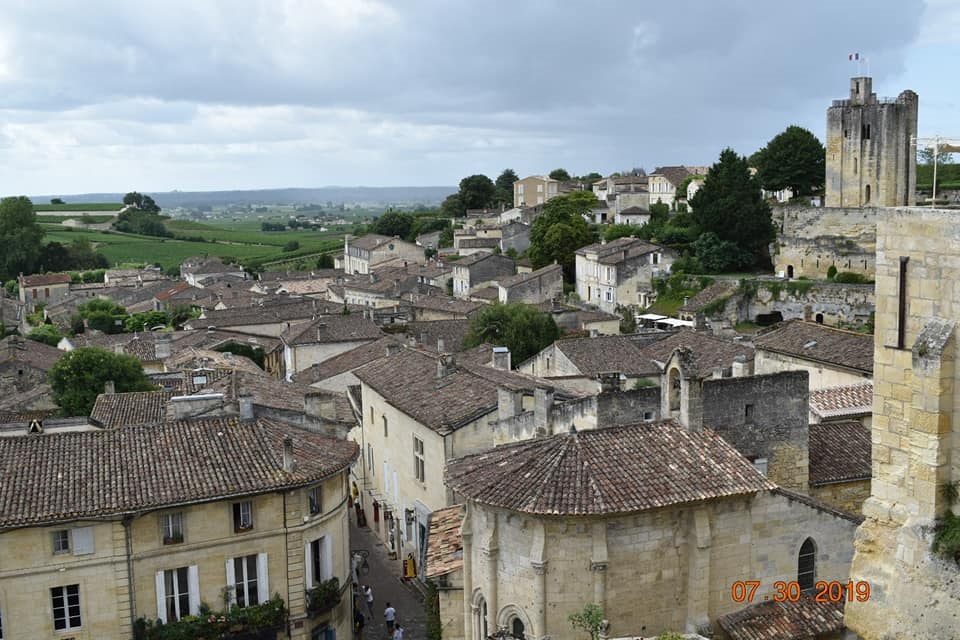
Top photo: The rooftops of Saint-Emillion, an hour’s drive from the Engebretson’s new home. All photos courtesy of Eric Engebretson.


Leave a Reply