
One of the greatest treasures of our East County home is the natural beauty that surrounds us: the trees, the trails, the river, the parks. When I moved here three years ago, I discovered one of these jewels right in our own backyard — the Lacamas Creek trail. Hiking up the trail to the waterfalls, over the bridge, and on to Round Lake is a truly awe-inspiring experience. Beneath the soaring Douglas firs and big leaf maples, masses of ferns, trilliums, fringe cups, and oxalis carpet the forest floor and capture the grandeur of the Pacific Northwest forest. It’s a beauty not just seen, but felt.

Well, that was my memory of the trail, anyway. That is, until this past March. I guess I had always waited to hike the hill a bit later in spring, early enough to see the trilliums and camas lilies in bloom, but late enough for the canopy to have leafed out. This year either I was early or spring was late, because my idyllic view of the trail evaporated.
It was an overcast day, with the weak sunlight just managing to shine through the bare tree branches and illuminate the ground below. In this in-between-seasons lighting, I could see what I’d never noticed before: ivy everywhere, ivy covering everything. My heart dropped as my awareness of how lethal this benign-looking invasive can be, how the ivy could obliterate the very nature of this woodland trail. Had it been this bad last year? As we climbed towards the waterfalls, I kept hoping the ivy shroud would begin to lift and give the native plants a chance to survive, but I saw only small patches of healthy ground that the ivy hadn’t yet reached.
As we reached the top, where the picnic benches offer seating, just before you cross the bridge, I hoped to find the first signs of the trilliums that always grow there. This was the first place I had seen trilliums when I first moved to Washougal. To me the trillium is the quintessential harbinger of spring and renewal. Often called “wake robins,” they bloom in woodland gardens even before the robins arrive to signal the start of spring.
But instead of the first shoots of trilliums, all I saw were more ivy vines!
“Oh no you don’t!” I actually cursed the ivy. I began to pull away the ivy vines that threatened to smother the trilliums.
“Oh no you don’t!” I actually cursed the ivy. I began to pull away the ivy vines that threatened to smother the trilliums. Yards and yards of vines I pulled up. Now, I had no idea if this was legal in a public park, but I knew something had to be done. Trilliums take years to mature enough to produce their blooms, and therefore their seeds. There was no time to check with anyone, so I pulled up all the ivy I could from the area. Now I had a huge bundle of ivy vines, evidence of my crime of passion. I decided to leave them in a bundle in the trees, away from the trilliums (and also from other hikers who might have wondered what ecological crime I’d just committed).
As we continued to hike on the other side of the bridge, I was relieved to see that the ivy was much less dense. And taking detours on some of the bike paths, I saw no evidence of the brute: a sigh of relief. Maybe that section would be spared.
When I got home, I felt I needed to confess my crime and learn if I could continue to pull ivy in the park.
When I got home, I felt I needed to confess my crime and learn if I could continue to pull ivy in the park. I called the Camas Parks and Recreation Commission, but the woman who answered had no idea and referred me instead to a nonprofit with a clever name: the Camas Ivy League.
The Camas Ivy league was the brainchild of Cassi Marshall, a former Washougal schools employee and long-time resident of Camas, who had an experience similar to mine in 2017. That was the year of record snow in East County, and, on one of the many snow days called by the schools, Cassi went out hiking at Fallen Leaf Lake and encountered the ivy menace there. Though she had frequently hiked those trails, which were near her home then, she hadn’t noticed how the ivy was smothering the trees and understory. But suddenly she did, and with that realization, she knew had to do something to save her park.
If you’re new to the ivy issue, you may be wondering what all the hysteria is about. After all, English ivy is beautiful and elegant; it covers the halls of major universities and estates back East and gives our country’s most learned institutions their famous nickname: the Ivy League. But ivy has become “a major invasive villain” in the Pacific Northwest, says Linda McMahan, a horticulturist with the Oregon State University Extension Service. In an online article, she wrote:
“Given a foothold, English ivy suppresses and excludes other vegetation to form a dense monoculture groundcover, unsuitable as wildlife habitat, except perhaps for rodents…. As a vine, it can completely engulf shrubs and encircle tree trunks of all sizes, leaving nothing uncovered. Shrubs shrouded in ivy may eventually die because light can’t reach their leaves. The sheer weight of the extra vegetation also weakens the plant it grows on, making it more susceptible to disease and blowdown.”
Given a foothold, English ivy suppresses and excludes other vegetation to form a dense monoculture groundcover, unsuitable as wildlife habitat, except perhaps for rodents.
Cassi was aware of the threat caused by the ivy, but she didn’t need to call a city or park office the way I did. As a member of the Camas Parks and Recreation Commission, she knew there were no plans to control or eradicate the ivy. She was also well aware of the limited budget and resources of the Camas parks. She knew it would be a daunting task to try to eliminate the ivy in Fallen Leaf Lake Park, and that all the Camas parks would need the same attention.
And so the Camas Ivy League was born. The nonprofit, which receives funding from the Camas Parks Foundation, works with the parks commission and the city of Camas to eradicate, or at least limit, English ivy in local parks and greenways. How? By creating ivy-pulling volunteer events. Their first event was at Fallen Leaf Lake Park in May 2017. In the five years since then, as the volunteers continued to “pull together,” several thousand local trees have been cleared of the ivy menace. This year alone, over 1,000 trees have been cleared in the first months of the season. After a summer break, the group’s goal will be to clear at least 2022 trees by year’s end.

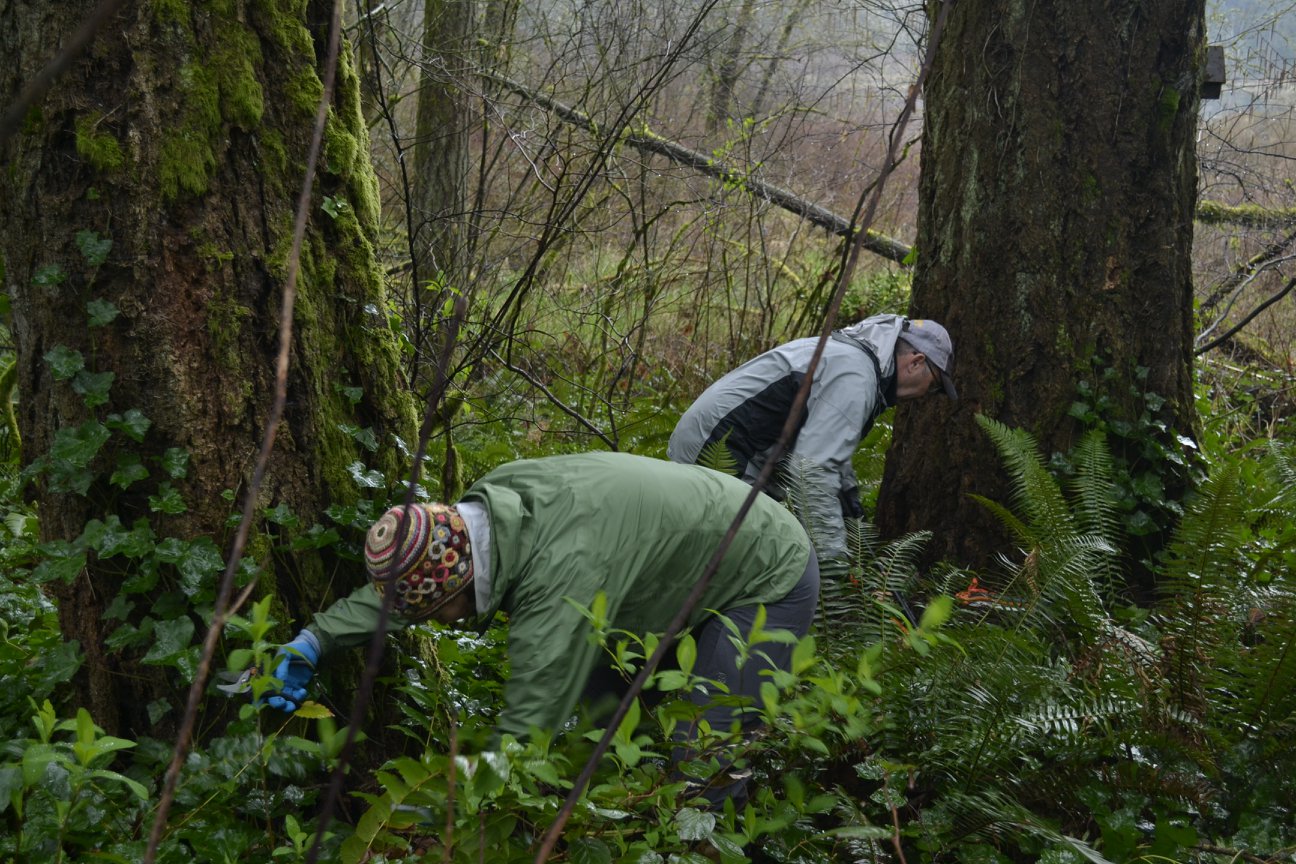
After meeting with Cassi at the Washougal Coffee Company, I signed up to participate in an ivy pull scheduled for this last March. Between 20-30 enthusiastic volunteers show up at each of these events, clippers and lopers in hand, to remove ivy from trees. The volunteers ranged in age from 7 to 70, all eager to take on the ivy invader.
I left the first pull, and the subsequent pulls I have attended, a bit sore and pretty tired. I have to admit, it’s a bit more strenuous than a walk in the park. But that fatigue is accompanied by such a sense of community and accomplishment. It’s easy to be overwhelmed by the immensity of the task, but I also get to feel like I made a difference — that one step at a time, with the community joined together in the same purpose, we can make a difference. And I am also in awe that one individual like Cassi saw a need in the community and stepped up.
If you’re interested in “pulling together” with the Camas Ivy League, find them on Facebook at https://www.facebook.com/CamasIvyLeague/ or email Cassi Marshall at camasivyleague@gmail.com. The next ivy pull event is Sept. 10.
Ginny Frederick is a dog-loving retired teacher turned gardener who forfeited the sun she loved in Texas for the grandchildren she loves in the PNW. Living and learning, she is always looking for ways to find beauty and purpose in her garden, her community and her life.
Top photo: Two volunteers work to clear ivy in Camas. Courtesy of Cassi Marshall.


Leave a Reply to AnonymousCancel reply