

By Scott Rainey
I’m a middle school teacher, and have been in the classroom since 1997. In that time I’ve shepherded my students through a lot of challenging situations, both universal and personal — 9/11, the loss of family members, the gladiatorial combat that is the social media landscape, and the vicarious trauma of school shootings so common across the country that they only manage to garner our attention when the body count is high enough. All of these pale in comparison to teaching during the pandemic.
In my mind, the line of demarcation is a date: March 13, 2020 — Friday the 13th, naturally. The strange illness that had been gaining prominence in the news made its appearance swiftly and remorselessly in our classrooms that day, because it was the day school shut down.
Being flexible and able to change on the fly is an essential survival skill. However, the changes thrown at us as a profession starting that Friday in March made us all look like veritable circus contortionists.
Everything in my perception as a teacher I now see as being on one side of that split or the other. It’s often said that a successful teacher’s middle name is “flexible.” The changes that come at you in a classroom would make your head spin, and especially so in a middle school environment. Being flexible and able to change on the fly is an essential survival skill. However, the changes thrown at us as a profession starting that Friday in March made us all look like veritable circus contortionists. Everything was at a scale unseen and beyond our imagining.
There is a proverb that states it’s better to be flexible like a willow than rigid like an oak, for the willow can bend in the wind while the oak might be blown down. For too many in teaching, the pandemic was the breaking point, even if they had been a willow in every other challenge. The loss of these teachers is a deficit that can only be remedied by time.
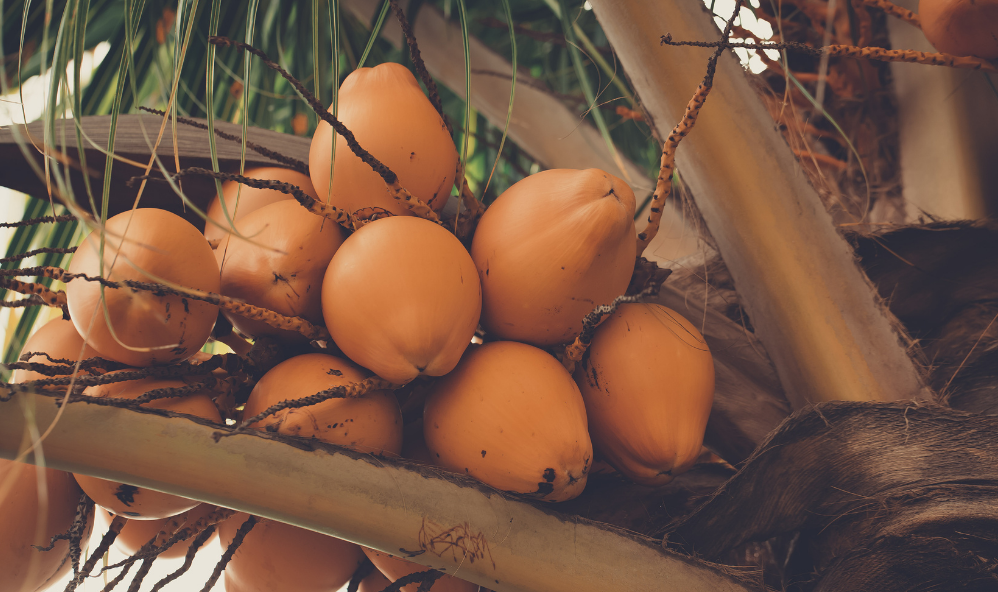
In the meantime, though, not all is gloom. In a profession where one is literally developing the minds and characters of our most precious resource, hope really does spring eternal. And for me, it came through coconuts. Or, at least, photos of coconuts.
In a profession where one is literally developing the minds and characters of our most precious resource, hope really does spring eternal. And for me, it came through coconuts.
Allow me to explain: I have a visceral hatred of coconut as an ingredient. The easiest way to completely ruin any food, be it a piece of candy, a cake, or a fried shrimp, is to include shaved coconut. To me, it’s all a texture thing, because I actually like the taste of coconut — it’s just the texture I can’t get past. Someone in my childhood made a ghastly analogy that has haunted me for decades, and now I’ll share it with you: Eating coconut flakes is like stuffing a bunch of fingernail clippings into your mouth. (You’re welcome).
In October of 2020, I had officially taught school exclusively online for a total of about five months: the remainder of the previous school year, and the start of the new one. Everyone can remember how things were at that point — a vaccine was still a distant possibility, mask-wearing had devolved from a measure to save lives into a morass of incomprehensible political virtue-signaling. Grown adults were spreading misinformation on any media platform they could access, and things were looking bleak. I could feel my own willow torso creaking under the pressure.
If you were a child attending my middle school, though, it was October, and pandemic or not, October means Halloween. While the kids had resigned themselves to the fact that there would be no trick-or-treating that year, the general buzz of ghosts, witches and hobgoblins permeated the atmosphere as it did every year.
As a means of engaging my students, I would begin every class session with a question of the day. I bought a book from Amazon that was a list of questions designed for kids, and we’d begin every period with one of these queries. They were designed to get kids to open up and talk, something that we found most kids were loath to do through their devices. Some kept their microphones and cameras turned off to preserve the privacy of a home in turmoil. Some kept them off to hide that they were otherwise occupied, often with a video game or phone app. And some just didn’t want to talk, overcome with the feeling of ennui coming from living in a world that was decidedly not what they expected it to be.
Some kids kept their microphones and cameras turned off to preserve the privacy of a home in turmoil. Some kept them off to hide that they were otherwise occupied, often with a video game or phone app. And some just didn’t want to talk.
Halloween was on a Saturday in 2020, and as anyone who has ever gone trick-or-treating as a kid knows, there’s no Halloween like a weekend Halloween.Having that sugar-fueled event on a Saturday as a middle-schooler was something one had looked forward to for years: if you were 13 years old now, you were 6 during your last Saturday Halloween. As your perceptions grew through the years, you came to realize that, while Halloween is always a good time, having it fall on a weekend makes it extra special. You could stay out longer, running amok with your friends and depleting as many houses of their sugary offerings as you could, so long as your legs hold out.
Knowing that this extra special Halloween was going to be of necessity a bust for my kids, I tried my best to soften the blow. I began my first class on Friday, October 30th, with my requisite question of the day. However, I flipped it around. The question as written was, “What is your favorite Halloween candy?” In order to provoke more engagement, I took the contrary position. I asked them, “What is your least favorite Halloween candy?”
As I hoped, microphones turned on as students weighed in to express their derision for different confections: more than a few expressed a distaste for hard candies (“They remind me of the ones that are all stuck together in a dish at my grandma’s house!,” one wit opined), and others swore that Milky Ways were forged in the deepest pits of perdition.
At last, the question came my way: “What’s your least favorite, Mr. Rainey?”
I instantly began to riff on my almost irrational hatred of all things coconut.
I instantly began to riff on my almost irrational hatred of all things coconut. Almond Joys and Mounds are easy marks and therefore easily avoided: they’re clearly advertised as having Satan’s Toenails as a major ingredient right on the label. I further explained that the stealth coconut found in the random chocolates in a Whitman Sampler box are of course more insidious, and the greatest crime of all is to take an otherwise lovely chocolate chip cookie and add slivers of despair to them. I was on a roll.
Suddenly, I noticed something. As I was carrying on, one of my students had changed his background to coconuts. Within seconds, another had followed. Then, over the course of about a minute, my entire screen was filled with images of my kids with virtual coconuts behind them. Throughout the rest of the class session, those images changed and morphed into dozens of variations on a theme — whole coconuts, half coconuts, coconut trees, and mounds of flake coconut.
I’m not sure what the actual lesson was that day, but I do know what my kids and I learned: we were going to get through this, and we were going to be okay. That day, I saw my kids being kids — something I’d missed for so many months. The pandemic took a lot away from them, but it didn’t take everything away. So long as a child can laugh, even at something as ridiculous as their teacher’s irrational hatred of a tropical delicacy, they will survive, and thrive.
I’m not sure I will ever get over the emotional trauma of all those coconuts, though.
Scott Rainey is a National Board-certified teacher who teaches 8th grade US history at Jemtegaard Middle School in Washougal, WA, where he has been on the staff since 1998. He received the Veterans of Foreign Wars Department of Washington’s Citizenship Education Middle School Teacher of the Year award for 2021-2022. He is married to his best friend, his wife Katrina, and is the father of three adopted daughters. He loves the Beatles, 80’s alternative rock, Shakespeare, Geocaching and traveling. He really isn’t fond of flake coconut.
Love this post? See “The Lie of the ‘Kumbaya’ Moment,” also by Scott Rainey.


Leave a Reply